

Look Up VW Parts Numbers
Volkswagen Part Number Lookup Tool for VIN Sourcing and Catalog Fitment
Locating exact component blueprints within our digital archive requires absolute mechanical tracking precision. Whether you are conducting routine filter upkeep on a fuel-efficient TSI engine, executing a brake overhaul on a performance GTI, or restoring an all-wheel-drive 4MOTION undercarriage, identifying components by general name alone introduces severe margin of error tracking.
Volkswagen vehicle architectures are engineered with strict German factory tolerances and closely integrated computer modules. The master lookup catalog at EuroParts4Less connects directly into active factory parts databases, giving you immediate access to authentic component blueprints, design evolutions, and real-time warehouse inventory records.
Operating a precision-engineered vehicle under demanding daily driving conditions (such as handling intense summer heat cycles, enduring constant stop-and-go highway congestion, or dealing with rough seasonal roads) accelerates the natural wear cycle of delicate mechanical networks and sensory arrays.
Implementing a proactive vehicle care timeline backed entirely by factory-certified parts is the single most effective way to safeguard your automotive investment. This rigorous methodology ensures that your vehicle's structural integrity, emission safety ratings, and dynamic driving systems remain fully synchronized across long-term ownership.
Two High-Precision Search Channels: Keyword Fields and VIN Tools
To handle whatever repair documentation or diagnostic workshop records you have on hand, our digital catalog portal is constructed with a split entry layout.
When visiting our lookup interface, you can route your inventory search through two dedicated processing pathways built to optimize component tracking and minimize logistics delays:
- Search By Part Number and Keywords: Located as the primary search block on the left side of our interface screen, this input field is ideal if you have a component sequence ready. It allows you to enter alphanumeric strings taken directly from a stamped factory casing, a mechanic's repair estimate, or a previous maintenance invoice to pull up real-time stock availability instantly.
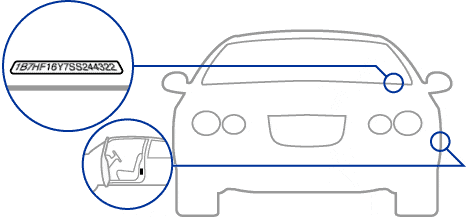
- Search By VIN (Ensure Part Fitment): Positioned on the right side of our lookup block, this system provides absolute validation. Entering your unique 17-character vehicle identification sequence completely handles your search parameters, analyzing factory option packages and specific build variations to isolate compatible components while hiding non-compatible items automatically.
Decoding the 3x3 Architecture of the VAG Part Number System
Volkswagen utilizes a highly systematic, standardized part numbering sequence created to record detailed engineering data within a 9-to-11-character string.
Most genuine factory components are split cleanly into three distinct blocks of three digits (formatted as XXX XXX XXX). Understanding how this structural sequence behaves allows you to decode the history and system assignment of your component directly from the stamp markings on the old hardware:
The Prefix Block (Digits 1 through 3): This initial segment identifies the original vehicle model family or specialized engine group for which the component was originally developed.
For instance, a sequence starting with 1K0 typically denotes a fifth-generation Golf platform build, while 5N0 marks a dedicated Tiguan component. Furthermore, the third digit frequently records steering configuration metrics, where odd integers signify left-hand-drive builds and even integers denote right-hand-drive systems.
The System Group and Subgroup Block (Digits 4 through 6): The fourth character represents the Main Group, identifying the primary automotive system area (such as 1 for Engine and Cooling, 3 for Transmission, 6 for Wheels and Brakes, and 8 for Bodywork and Interior panels).
The fifth and sixth characters establish the specific technical Subgroup. Crucially, whenever the fifth and sixth digits read as 98 (yielding an XX9 8XX layout), the catalog identifies the item as a complete comprehensive repair kit or axle set rather than an individual loose fastener.
The Component Identifier Block (Digits 7 through 9): These final three sequential digits pinpoint the exact individual part within that mechanical group. This section also tracks component orientation on the chassis. Following factory indexing rules, if a component is side-specific, an odd final digit indicates a left-side placement (driver side), while an even final digit represents a right-side placement (passenger side).
The Suffix Modification Index and Color Code (Optional Post-9 Digits): If a part undergoes a manufacturing design update, a material formulation revision, or a supplier swap during its production life cycle, factory engineers append an alpha character modification letter (such as A, B, or moving up to J) to the end of the base nine digits.
This modification index changes the part code entirely, meaning a part ending in letter A might not interchange with a revised version ending in letter H. Interior trim panels or exterior body moldings add an extra three-character alphanumeric extension to designate exact factory paint or interior dye matches (such as 01C or B41 for specific variations of black texturing).
The Complexity of PR Build Codes and Modular Platform Splits
One of the most frequent challenges when sourcing genuine Volkswagen parts online involves navigating hidden production variations known as PR codes (Production Codes). Volkswagen heavily utilizes these three-character alphanumeric build identifiers (such as 1ZE or 1LM for specific braking diameters) to define the exact mechanical equipment installed on the assembly line.
Because of this, two vehicles sharing the identical model year, trim name, and engine displacement can require entirely separate front brake rotors, alternator outputs, or suspension control arm bushings based on their specific factory build sheet options.
This complexity is magnified by Volkswagen's widespread use of the modular transverse matrix (MQB platform) and modular electric drive matrix (MEB platform).
Because multiple vehicle lines share underlying chassis geometries, components often cross over between models, but small updates in electronic pin alignments or bracket offsets can prevent a part from connecting safely. Attempting to buy components using broad catalog photographs or simple descriptions introduces significant procurement risks.
Safeguarding High-Sensitivity Systems with Electronic VIN Matching
While basic interior trunk liners or simple license plate trims allow for minor margins of variance, high-priority mechanical and electronic systems demand absolute data verification prior to checkout.
Direct-injection fuel pumps, high-pressure common rail components, DSG dual-clutch mechatronic control valves, and advanced driver-assist safety sensors tie directly into your central vehicle stability computers. Installing a loose-tolerance, unverified aftermarket substitute can trigger persistent dashboard warning lights, degrade system performance, and cause early component wear.
Utilizing our right-hand VIN lookup tool completely bypasses this risk. By inputting your unique 17-digit tracking code, you instantly reference the official factory build record, filtering out non-compatible variations to ensure that every individual filter, sensor, and mechanical assembly fits flawlessly on your very first installation attempt.